![]() |
|||||||||||||||
Asbestos, Fibrous Asbestos Cement Sheeting,F.A.C. or Fibro.Background
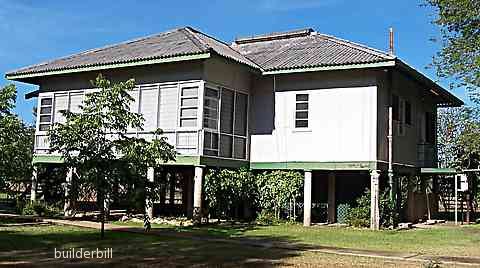
Fibrous Asbestos Cement products, like the wall and roof sheeting on this classic 1930's house, are commonly called Fibro in Australia. Building specifications used to refer to " FAC sheeting". Some people still use the term Fibro for any flat cement sheet, but here I will use the term to mean products containing asbestos fibres. Thin cement sheets, which are as thin as 4.5mm thick, have to be reinforced with fibres which for a long time were asbestos. Now the reinforcing fibres are usually cellulose. Fibro is a building product that has been around for a long time. In the post WW2 years, the 50's and 60's, it is estimated that a third of new houses built in Australia used Fibro somewhere.
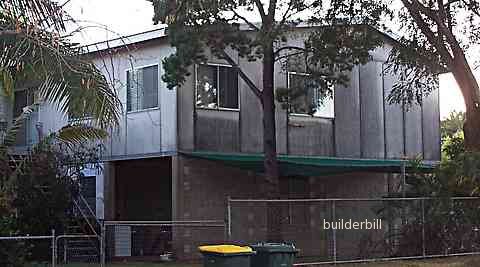
Here is a less than classic old Darwin house, that I worked on in 1965 (I did the second fix). It was obviously re clad with Fibro after cyclone Tracy (1974). This and other photos taken May 2007. FAC was cheap, easy to use and maintenance free. Look at the house above, the external walls have never been painted. That's nearly 40 years. Why wouldn't you use it? Well I don't think there would be many people considering using it after all the publicity with the various Asbestosis claims against James Hardy and Co.
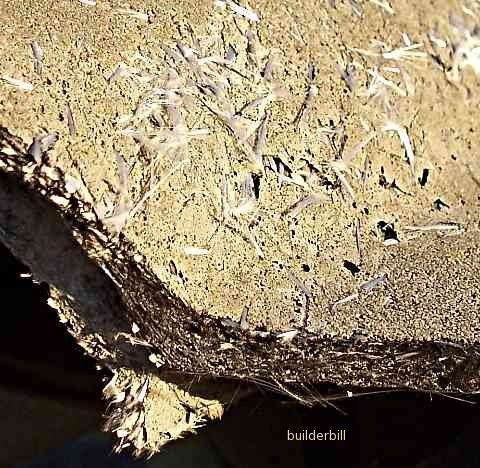
In the above photo, of a hip flashing on a "Super Six" corrugated FAC roof you can get an idea of how many asbestos fibres are actually in there. There is also an indication that the corrugated sheet underneath was cut with a grinder or more probably a power saw with an abrasive disk.
Another shot of the same roof. The coating of cement has just about weathered off in a lot of places, and the fibres are free to blow away. Breathing in asbestos fibres can cause asbestosis, lung cancer and mesothelioma. Only cement sheet products made before 1987 contain asbestos. In NSW, for example, the use of asbestos was discontinued in cement sheets by 1982, in corrugated sheets by 1984 and in all other products by 1986. Products containing asbestos have been totally banned in Australia since 2004. But, that means there are still a lot of houses out there that contain it. Places You May Find Fibro and Other Asbestos Products Around The Home.
Fibro in Your HouseIf you have a house with Fibro on the walls and ceilings, don't stress out. Fibro is OK if it is not deteriorated to the extent that the surface is losing it's cement layer. The flat sheets are very stable and if they are not disturbed, it is perfectly OK to live in a house with internal and external Fibro sheeting. Just make yourself aware of it and take sensible steps to avoid damaging the sheeting. Corrugated Fibro Roof SheetingIf your house has the corrugated sheeting on the roof:- Start thinking about replacing it. (The roof). Unlike the the flat sheeting which has a different ratio of cement to asbestos the corrugated has a definite "use by date" and I guess that any roof that still has it on won't have a lot of life left in it. This is only my experience, I have not seen this documented anywhere. Keep off the roof. Full stop. If you must go on the roof, be EXTREMELY careful walking on it. It seems to attract mold and mildew and when only slightly wet it is very slippery. Walk only on the battens. (They are under the nails or screws). It loses it's strength with age and if it is damp after rain it is far worse. It very easy to go through the roof. I did an extension to a large Fibro roof years ago and I had no less than three guys go through the old roof, experienced tradesmen all. Not all the way through of course, a foot or a leg, a few cuts and bruises, but large holes that needed fixing. I have sealed one large Fibro roof to stop the thing deteriorating, and I am surprised it has not been done more often. Now this type of preventive measure is a bit too late. For a start it is illegal to use a water blaster on Fibro and any type of work on Fibro has to be done by a licensed contractor. Buying a House with Fibro in ItThe only way I would knowingly buy an old house with a lot of Fibro in it, is for the land value. I would allow the cost of a licensed asbestos removalist to get rid of the stuff and the cost of the demolition on top of the house price. They are not "renovator's dreams". So how do you avoid unknowingly buying a house with asbestos in it?
Renovating a House Containing Fibro.If you own a place that you suspect may contain fibro, find out what is what. It could cost you heaps if you get it wrong. Otherwise for small jobs treat any cement sheets that you know were fixed before 1990 as containing asbestos. The problem with asbestos is in the breathing in the fibres or dust. It doesn't cause any external symptoms like rashes or itches. It all goes on inside your breathing system. So follow these guidelines.
I am working from memory now, but here in the NT a home renovator can remove up to ten square M. of asbestos related materials from his own home. This is provided that he does it to "Worksafe" recommendations. This quantity is not much at all, but I believe in other states it is a lot more. More than this he has to use a licensed asbestos removalist. Removing FACSo if you are thinking of doing it yourself, you could save some money, but you will have to put some effort into it. I will give you a run down on what I used to do when I had a license.
I had a license that is typical for builders, that allowed me to work with FAC only. Not the far more dangerous types of asbestos, blue asbestos, found in pipe lagging etc. I have seen guys working with that stuff removing the lagging from pipes at a power station. They wore waders and worked in what was similar to an above ground swimming pool. The lagging was separated from the pipes and bagged completely under water. A Question From a ReaderChris from Sydney writes: Dear Bill Hi Chris, Your first and cheapest option is just to cover up the holes with say panels of cement sheet. Or cover the whole ceiling with a new lining. There is no requirement for you to remove it. Otherwise, I would say check out your local regulations in regard of home owners being able to remove up to a certain small amount without a license. To do it yourself is not hard, and you would be working in just about the easiest conditions you could get. If your garage is lockable the dust can be contained in that area easily. If you can't do it yourself, go to the "Worksafe" authority and get a list of licensed removalists. There will be a lot of names on the list who will be similar to myself, people who have the license so that they can do the work for themselves as jobs crop up, but they don't advertise the fact. You may find someone in your area. If you have already been using the list, you could try suggesting that you are prepared to do the job yourself under someone their supervision. I have done this myself for a builder mate of mine. I told him what I wanted him to do and how to do it, I did all the paper work and charged him a fee for supervision. Good luck with it Chris My View, Take the Risk or Not.
The photo on the right was taken with a bit of humour at the time, but now I cringe when I see It. In my early days in Australia I handled an awful lot of FAC. For the most part it was flat sheets and was cut with fibro cutters, which made little dust. Even so, sweeping up the scraps etc. exposed us to the dust. When we fixed the corrugated sheeting, there was only one tool, an abrasive disk in a grinder or saw to cut the stuff, and it had to be cut a lot. There were not the same diamond / wet cutting tools that are available now. Obviously at at the hips all the the sheets had to be cut. Sheets did not come in long lengths like today's modern metal roofing, so each overlapping sheet in the length also had to have a corner cut off, also by disk. In the 60's and 70's there were vague warnings about using masks etc. and for the most part we used them, but again they were not as good and as cheap as modern masks. So, myself and thousands like me got were exposed to asbestos dust. I am still OK and so are thousands of others. Would I do it in the same way again? NO WAY. I believe it's a bit like a lottery, millions of us don't get that ticket to hospital, but are you willing to take the risk, not only for yourself but for your family and others as well, just to save a few dollars? DO IT CORRECTLY, FOLLOW THE GUIDELINES. Disclaimer: This is a highly complex and stringently regulated field. I am not a scientist, I am not a government spokesperson or anyone with any authority to talk or give professional advice on the subject. What I am is a retired builder with a fair amount of practical experience, of fixing fibro and then later removing it. I was for a few years a licensed (limited to FAC) asbestos removalist. I hope you got something of value out of it, but treat it on the same level as something you got from an (interesting? boring?) old fart in the pub. In other words, check out the regulations where you live, and comply with them. If you have any doubts get advice from a licensed person in your area. Here is a US site, with more information on asbestos and air quality, public health issues that I found interesting. If you happen to live in Sydney and are looking for a contractor to remove and replace you old asbestos roof, check out Lidoran Roofing. Leave this page and back to home page
Home |
Roofs |
Roof-sheeting |
concrete |
formwork |
Trim-Carpentry |
Decks |
stairs |
doors |
hand-tools |
Electric-tools |
ceramic-tiles |
Asbestos |
MDF |
Hurricane-Construction |
Tropical-Building |
Low-Tech |
Recent-Updates |
Talk-and-Tips-Blog |
Contact |
Who-am-I |
Site-Search |
diy-links |
Site-Map |
|
Sign up for your monthly dose of "Wrinkles".
Looking for something specific? Bill's Site Search will find it, no probs.Post any questions or comments here on my contact page.Once you make the initial contact we can email in the normal way. The contact form is a pain, but it is to stop spammers.Other Misc. topics Pages. |
||||||||||||||
|
|
|||||||||||||||
|
Please Note! The information on this site is offered as a guide only! When we are talking about areas where building regulations or safety regulations could exist,the information here could be wrong for your area. It could be out of date! Regulations breed faster than rabbits! You must check your own local conditions. Copyright © Bill Bradley 2007-2008. All rights reserved. |
|||||||||||||||