builderbill

A Bathroom Renovation

Are you in need of a bathroom renovation? We were and here are some of the ways that I went about sptucing the old place up.

On this page.
Removing The Old Cabinet | Replace Water Fittings | Removing Old Floor Tiles | Removing The Old Wall Tiles | Fixing the New Bath | Mixing Setup for Topping Mortar | Cement Additive, PVA Type


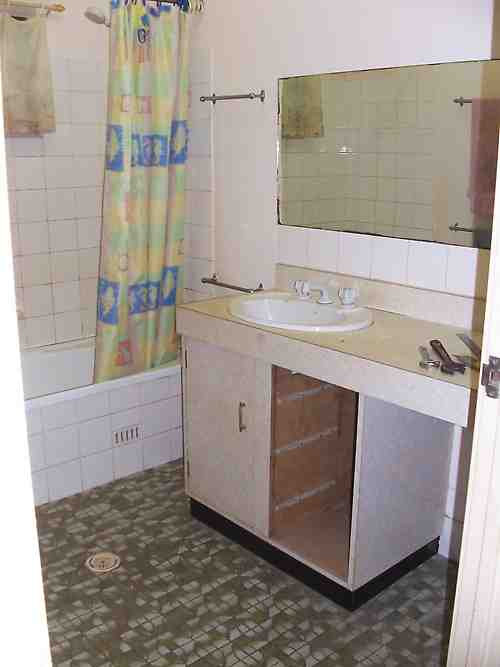
Old bathroom
Bath renovation - In need of a face lift.

Here is a shot of the old place (the height of elegance in 1976  :-) just after I started working on it.  The digital camera that I use is fairly modest and it usually does me well enough, but for indoor shots a wide angle would be great.  So apologies for the less than adequate photos.

The house is a ground level, about 30 years old and much in need of an internal refit.  The walls and floor are concrete.

The bathroom is quite small 1800 x 2000, so there was not really enough room to build a separate shower and a bath, so I went the path of least resistance and didn't change the layout at all.  Because the bathroom layout was unchanged, it meant that I didn't need to involve a plumber.  So I can say it is just a bathroom renovation and not a total remodeling.

back to top

Removing The Old Bathroom Cabinet and Saving The Ceramic Hand Basin

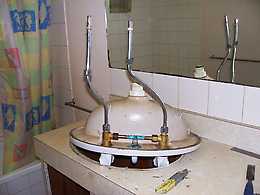
The first job was to strip out the old bathroom cabinet, and to remove the hand basin without breaking it, and put it to one side for later.

bathroom basin
Bathroom renovation - Removing the bathroom handbasin.
  • I bought some thread tape and some 1/2" cap nuts for the water pipes.
  • Turned off the water at the mains.
  • Crawled under the basin and pulled out the plastic waste system, "S" trap etc. Water spilled out of the trap when I loosened it but no problem in this case. (otherwise I would have had a bucket handy).
  • I undid the water fittings at the wall.
  • The basin was fixed with metal hook ties to the underside of the bench top and they had to be undone.
  • The basin had also been sealed to the top of the cupboard with a sealer, and I ran around the rim with a utility knife a few times, and then slid my 600mm steel ruler under and poked and scraped it around, to break the seal and finally wriggle the whole lot free.  Wriggle being the operative word here, don't get impatient, it will come eventually.
  • The old bathroom cabinet came out easily enough after that with a bit of prying with a pinch bar and hammering.  It was fixed to the wall with masonry anchors, and I managed to unscrew them fairly easily without use of too much force.  Again it is easy to wrench something off a wall with a bar, but you may pull out section of the plaster or wall surface as you do it.  It is always advisable to unscrew fixture if possible.  This is one of the reasons I love my little impact screwdriver, it has that ability to rattle out old screws.
  • The parts of the masonry anchors left in the wall, I cut off with a cutting disk in my 100mm grinder.

Back to top

Replace Water Fittings and Thread Tape

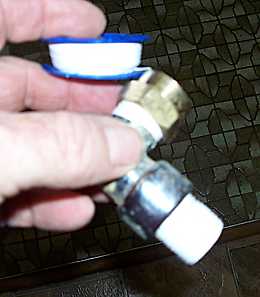
Thread tape
Bathroom renovation - Using thread tape.

Once the cupboard was gone I put the plugs on the ends of the water pipes coming out of the wall using half a dozen turns of plumbers thread seal tape on each joint.  Water fittings like this seal actually on the thread.  The thread is tapered, and it is always sealed with thread tape, or ribbon dope as it is sometimes called.

The bathroom fitting that takes the water to the basin, via a copper pipe (see the photo above) relies for it's seal on a plastic "olive" (sometimes soft copper) and does not need thread tape.

When I put the basin back later, I replaced all the olives.

The old bathroom mirror on the wall was to be thrown away, but I still managed to get it off in one piece.  It had been glued to the wall with "Liquid nails".  I taped it all over with packaging tape, and wriggled an old 600 long steel rule behind it to break the glue and using gloves got it off OK.

Back to top

Removing Old Floor Tiles

old floor tiles
Bathroom renovation - The old mosaic floor tiles.

The next job was taking off the old bathroom tiles, starting first with the floor.  Before starting off this work I tore up an old towel and used a piece to stuff down the handbasin waste pipe, and later the floor waste and the bath outlets, to stop dust, chipped tiles and mortar going down the waste pipes and blocking them up.

I fixed a portable floor fan temporarily to the outside of the bathroom window, to suck the dust out, closed the doors to the rest of the house and kept the bathroom door closed as much as possible.  Then wearing gloves, dust mask and safety goggles I got stuck into this not so enjoyable job.

The floor itself was drummy.  By this I mean that it was no longer solid, but when I tapped it, with say the plastic end of a screwdriver I could hear a hollow sound.  If you want to check out a tile job, just tap it here and there with a hard object (not a hammer though:-) and you should hear a uniform solid sound.  If patches sound different it means they are not totally bonded and sooner or later you will get problems.

I soon found out that it wasn't the old bathroom floor tiles that were loose, but the old cement topping was loose onto the main concrete floor.

Makita breaker
Bathroom renovation - Electric jackhammer or demolition breaker.

My small Dyna Drill was a bit small and underpowered so I had to get the larger Makita breaker out, and that lifted up the tiles and topping easily, leaving a fairly clean concrete surface.

The topping was about 40 thick at it's thickest.   It is always a trade off between time and cost when you are trying to decide whether to go and hire a larger machine if the small one is taking too long to do the job.

I almost always go for the right tool to do the job. This sort of work is hard and dusty enough, without prolonging it.

back to top

Removing The Old Wall Tiles and The Old Baked Enamel Bath

Tap removal
Bathroom renovation - Removing the taps.

I left the old bath in place and removed all the old ceramic wall tiles fairly easily with my Dyna Drill with a chipping chisel, but the wall surface was very patchy.  Some of the old glue came off with the tile and some stayed behind.  I pulled the old taps off using a cheap box spanner as my socket set was just too thick to undo the retaining nut.  In the plumbing section of your store where you might be buying your new taps, they will have cheap box spanners that are made just for this type of plumbing renovation work.

The next job was another bit of a struggle, removing the old bath, which was a standard pressed metal one, with a baked enamel finish.  It had a couple of small chips, where something had been dropped into it, and the bottom surface was worn and looked faded, so I had to replace it.

recess for bath to fit into
Bathroom renovation - The wall recess that the bath fits into.

Where baths are against a wall, they are set into the walls, either masonry or stud walls , about 20mm, so that the wall tiles can overlap the lip on the bath.

Most of the cement mortar around the bath came loose and I removed it when I was chipping the tiles off.  It was still locked in solid though, and I had to remove the brickwork in front of the bath.

I punched a decent sized hole in it with the Dyna drill, then got the rest of it out with a lump hammer.

After getting the front wall down, I was able to slide the bath sideways and roll it out.

In the photo above and in the one at the top of the page, you can see the vent slots in the wall, which are there to give ventilation around the bath and to help stop condensation.

bath opening showing timber on walls
Bathroom renovation - Existing timber supports for the bath.

In the photo at the right at the bottom  right of the outside wall, you can see another opening which vents through the wall to the outside air.  It is rare to see these vents in new bathrooms, so I decided to say that the outside one would be sufficient and not to replace the inside vents.

You can also see that brickwork has been built up, to suit the length of the bath.  I left that intact, as I was going to use a new bath that was the same size as the old one.

Also plainly visible are the pieces of hardwood timber that are there to support the edges of the bath level while the rest of the building in process goes on.  I checked them, and they were still level and solid so I used them again.

back to top


Fixing the New Bath

setting up the bath
Bathroom renovation - Installing the new bath.

At the right I have slipped the bath into position and I have my level on the top testing it for level.  The top perimeter is set level and the manufacturer has a fall to bottom of the bath to the outlet.

I was lucky in that I could get a new bath with an identical layout so that my new outlet fit nicely into the existing waste pipe.  The chrome outlet to the bath has a rubber type washer underneath to form a seal, but I also put a bead of bathroom silicone  between the chrome fitting and the inside of the bath.  A good clean of the PVC waste pipe joint with a clean rag and PVC primer/cleaner, then I made the joint with solvent cement and lowered the bath into position, with the outlet sliding nicely into the PVC pipe that was concreted into the bathroom floor.

Bath set in position
Bathroom renovation - New bath in position. The trowel in front of the bath is an old brickies trowel that has had the point cut off, just right for getting the mud out of the buckets.

Here's the new bath set into position.  The recess in the walls to the bath has been plastered up with sand and cement mortar.  The bath has three large pads of support under it.  Usually I just use a very dry stiff mix of mortar to pack up under baths like this, but I had some 50 thick cement pavers handy so I used them with mortar joints.  This give the bath a nice solid feel.

When baths are just sitting on the outer rim they feel and sound hollow.  The bath manufacturer's blurb says support around the perimeter, with no mention of underneath support,  I have never seen a bath put in without support underneath.

In this photo I have just laid a bed of mortar to start bricking up the front of the bath.  The trowel I have laid it with in the foreground is a brickies trowel that has the pointy end cut off with a grinder.  This makes a nice tool for mixing and getting mortar and tile adhesive out of mixing buckets.

I laid 400 x 100 x 100 blocks to start of with and then cut some narrower at the top to allow extra space for a bit of plaster and the tiles to sit under the rim of the bath.

I almost always go for the right tool to do the job.  This sort of work is hard and dusty enough, without prolonging it.

back to top

back to top

Mixing Setup for Topping Mortar and Ceramic Tile Adhesive and Grout

Mixing set up for small cement jobs
Bathroom renovation - Mixing set up

The next job I had to do was render the bathroom walls where the old tiles had been removed, and fill up a few generally rough patches.

mixer
Bathroom renovation - mixing set up
  • Here are a couple of shots of my mixing setup.
  • Fresh washed brickie s sand.
  • Fresh bag of standard Portland cement.  I don't mind using old part bags of cement for odd jobs, but I always lie fresh stuff when doing a job like this.
  •  Shovel, couple of trowels and a plaster's rectangular float.
  • Home made plaster's hawk.  A square piece of 3mm aluminium with a handle on the bottom.
  • My large slow speed drill with big mixer in it.
  • A couple of 20 liter drums for mixing the mud in.
  • A larger garbage drum full of water for washing the mixer in after each mix.
  • A 4 liter tin of "Bondcrete".  A PVA type of cement additive that improves adhesion, water resistance and strength of thin layers of concrete and cement render.  There are many similar products.
  • Not shown in the photo is a couple of large sponges, the type you use for washing cars.
  • I have quite a few different length screeds handy.  They are straight lengths of box section aluminium that I have collected over a period of time for straightedges etc.  A couple of straight pieces of timber would be OK, or even an old aluminum level.
  • I also have a sieve that I can use if the sand gets lumps in it.  If you have lumps of stone etc in the sand it is a real pain.  A lot easier to sieve the sand first than pick them out of the mud later.

back to top

Cement Additive, PVA Type, "Bondcrete", "Lokcrete" etc.

I always use the PVA "Bondcrete" type additive for this sort of work.  Read the instructions on the tin.  It is a thick milky white liquid that could be just about the same as PVA wood glue to look at.

  • I get a section of wall ready by sweeping off the loose dust and then I wet it down with water, if the wall is very dry and porous it will soak up the moisture in the plaster too quickly and compromise the bond.
  • In one of my buckets I mix Bondcrete 1 to 10 (or a little bit thinner) with clean water to make my mixing water. So, the cement render has  Bondcrete evenly mixed into it.
  • I prime the prepared wall section with Bondcrete diluted at say 4 or 6 to 1 with water.  The idea is to lay on your plaster, while the Bondcrete is still tacky, so I only do a small section at a time.
  • I put my mixing liquid (water and Bondcrete) into my mixing drum and add cement, and give it a quick stir, then add the sand.  The ratio is about 4 to 1, sand to cement.
  • I only make up enough, say half a bucket, that is easy to carry inside and easy to get onto the wall.  If I made up a wheelbarrow full I might not get it all used before it starts stiffening up.  Don't mix up too much, until you get a feel for the material and how long it takes to go off.  It is different slightly from plane sand and cement.
  • This cement render with the additive in it is good stuff, and consequently sticks like you know what, to your tools, the floor and anywhere else you might splatter it.  Allow yourself time to clean up well.
  • A main fault of home plaster and concrete work in general is that because the work is hard and physically tiring, when the plaster is on the wall or the concrete screeded off, people relax, have a rest, maybe a beer or two and forget about the clean up.  
  • I am not an expert plasterer by any means, so what I do is get it onto the wall as good as I can with the steel float, (rectangular trowel) not playing about with it at all, then when it has had a bit of time to stiffen I use a screed to level it a bit better.  But where a plasterer will then finish it perfectly, I like to leave it a lot longer, and then scrape the almost hard plaster flat with the edge of a screed.
  • Any bits that fall off, or hollows, I patch up in a second session.

back to top

Click here for bathroom renovation page two which covers making good the walls and topping off the floor.  Then the all important waterproofing, followed by fixing the cabinet.


Not found it yet? Try this FAST SITE SEARCH or the whole web


XML RSS
What is this?
Add to My Yahoo!
Add to My MSN
Add to Google


ADD TO YOUR SOCIAL BOOKMARKS: add to BlinkBlink add to Del.icio.usDel.icio.us add to DiggDigg
add to FurlFurl add to GoogleGoogle add to SimpySimpy add to SpurlSpurl Bookmark at TechnoratiTechnorati add to YahooY! MyWeb

Please Note! The information on this site is offered as a guide only!  When we are talking about areas where building regulations or safety regulations could exist,the information here could be wrong for your area.  It could be out of date!  Regulations breed faster than rabbits!
You must check your own local conditions.
Copyright © Bill Bradley 2007-2009. All rights reserved.
Page copy protected against web site content infringement by Copyscape