 |
|||||||
Graphical Construction Glossary >> Tools. >> Power Tools >> Chain Mortiser
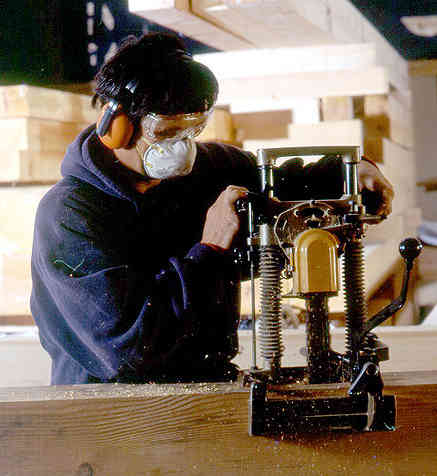
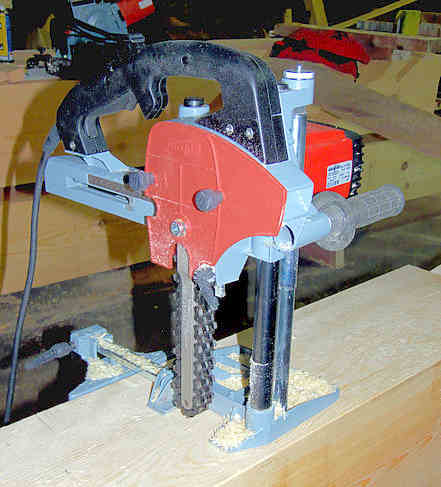
I can remember the very first time that I saw one of these portable chain machines. In 1966 I was hitch-hiking around Japan and I wandered onto a building site in Kyoto. The guys were building a traditional Japanese timber frame house, with the frame being about 6" thick. All the joints, studs to plates were mortise and tenon and while the guys did a lot of hand work, they had one of these portable machines that was built by Making. In the time span between then and now, I have no doubt that Making have improved their mortise no end and also that there are now a large amount of other companies that make them. At that time I had never seen a portable machine like this in either the UK or Australia. I had seen and used very heavy solid cast iron framed workshop machines, but what amazed me was the fact that the portable mortise was performing as good as a workshop machine in respect of the cutting, but it has the advantage or being portable.
While chain mortises are a lot faster than hollow chisel mortises they are slightly rougher. The downward side of the chain leaves a clean cut, but the other side, the upward cut leaves whiskers or sometimes splinters. The trick to stop this is to do a shallow cut first so the the upward end is angled say 45deg. then cut to it but not quite. So that maybe 1/16" of the bevel is left showing.
If you didn't find exactly what you are looking for try this search tool that will search the site and the web. "What can be added to the happiness of a man who is in health, out of debt, and has a clear conscience? "When we build, let us think that we build for ever."John Ruskin 1819-1900 |
 Hire Equipment  Furniture Fittings - Architectural Hardware - Electronic Locking Systems - Technical Hardware BuilderBill sponsorship Glossary Pages.Roof Glossary and Roofing Formwork Glossary and other tempory work. Hand Tools Glossary Power Tools Glossary Asbestos Glossary Woodwork Glossary Stair Glossary Concrete Glossary Masonry Glossary doors Glossary BuilderBill Books Building Maths  Stair Design  Asbestos Book |
||||||
|
|
|||||||
|
Please Note! The information on this site is offered as a guide only! When we are talking about areas where building regulations or safety regulations could exist,the information here could be wrong for your area. It could be out of date! Regulations breed faster than rabbits! You must check your own local conditions. Copyright © Bill Bradley 2007-2012. All rights reserved. 
|
|||||||